Check out these popular conversations from my community

Powered by BlogFrog

Monday, June 18, 2012

Le Grande Hermine

The ship that Cartier sailed on during his second voyage to find the Northwest Passage in Canada, thereby exploring the St. Lawrence River. Le Grande Hermine. Pictured below is a replica of the ship exhibited at 1967 World Expo in Montreal.


A drawing of the ship at sea. The second voyage was fraught with storms:


Saturday, May 26, 2012

Pattens again!

I am fascinated almost to the point of obsession regarding pattens. I wrote about them here and here. And below is another pair!

 
From the website where I found these:
"Pattens were worn to lift the shoe out of the dirt and damp. Being somewhat heavy and clumsy, they were mainly used by working-class or country women.
These pattens, however, have pointed toes to fit a fashionable woman's shoe and a depression at the back where a small heel could sit. The shoe would have been fastened into the patten by means of ribbon-laced latchets. All this, and the fact that the latchets are covered in velvet, suggests that the patterns were worn by someone of considerable wealth."

UPDATE:
PATTENS ARE BACK!

They probably never went out of style. But when this came scrolling across my dash I was happier than a puppy with two tails. Not that I'd ever wear these, but it seems that everything old is new again. As it says in Ecclesiastes 1:9:

The thing that hath been, it is that which shall be; and that which is done is that which shall be done: and there is no new thing under the sun.

Friday, May 25, 2012

Pattens -- Fancy ones this time!

Remember when I wrote about pattens? Today we wear overshoes or boots, but in the middle ages and forward, people wore pattens to keep their feet dry or out of the mud. Look at these 18th century beauties! 


Aren't these just delicious? I'm not sure how well they kept one's shoes tidy in deep mud, but the thought of a dainty lady wearing these to protect her new shoes is fascinating, isn't it? The pattens are as pretty as the shoe!

Tuesday, May 15, 2012

Artifacts from the Mary Rose

In my last post, I wrote about Carracks--the type of ships that Jacques Cartier sailed in when exploring what is now the area of Newfoundland.

I also mentioned the ship, the Mary Rose, which sank on July 15, 1545 and was discovered and resurrected from the depths in 1982.

This post highlights some of the artifacts from this ship. Its discovery gives modern historians the clearest revelations of day to day Medieval life ever studied. From shoes, to musical instruments, many things can be learned from this incredible find. I am using these artifacts to help me in my research of my book on Jacques Cartier.


A collection of daggers. It's amazing how preserved the hilts are.

 
 Lantern (above) and candle holder (below lantern). When you realize how much the Tudors relied on fire to see at night it's amazing that more fires didn't occur aboard rocking ships.


A comb and its leather pouch. If you look really close at the right hand side of the fine toothed comb in the first pic above you'll see a 500 year old nit!


Leather bucket.

 Wooden bucket.

Wooden tankard. Sailors were rationed a gallon of beer a day. 


Carpentry tools. Imagine trying to build a ship or home with tools like these.


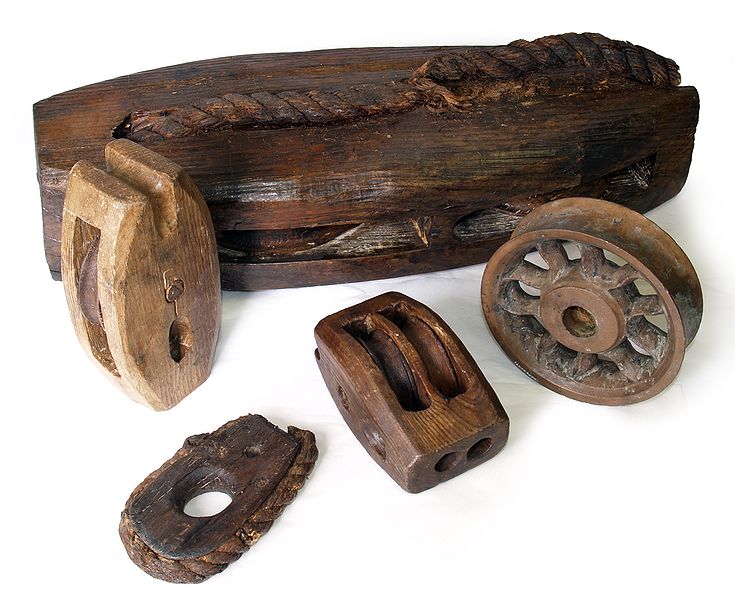
Rigging blocks and their pulleys. Even some of the rope is preserved. Amazing.


 This is part of an anchor rope. Check out this video to see how huge it is. For those who are landlocked (like me here in Indiana) it's hard to visualize these things in real life. This video was a revelation!
It's been amazing fun researching this book. Now I'm back in the cave putting all the pieces together on paper! When you read the book, you just might see some of the interesting artifacts mentioned here. 


Monday, April 23, 2012

The Ships of Jacques Cartier

Jacques Cartier explored the New World in ships known as carracks. You can spot a carrack by looking at its side. It forms a sort of "U". Below is a painting entitled, "Portuguese Carracks Off a Rocky Coast."


Carracks were the most common types of ships used by explorers in the 1500s. Columbus' ships were carracks. Below is a painting entitled "Ships Trading in the East" by Hendrick Cornelisz Vroom.


The painting below is a wonderful illustration of the differences between the Great Carrack; Spanish Caravel and Galleass. It was painted by American artist Frederic Leonard King. They look similar to the untrained eye, but there are subtle and not-so-subtle differences if you study them closely. Can you see them?


Henry VIII's warship The Mary Rose, was a carrack and is being restored. She was the largest ship in the navy. (I will post some of the ship's artifacts in a future post.) Here is an artist's depiction of her from the the only known fully illustrated inventory of ships of the English navy in the Tudor Period known as the Anthony Roll.


 In the picture above you can really see the "U" shape, can't you? Keep in mind that this is an artist's interpretation of what he saw and not necessarily accurate.

The picture below is The Mary Rose being restored. She was raised in 1982 after being underwater for 437 years. She has her own museum now and when it opens it will be an exciting and  realistic glimpse into what these ships were really like. 


By the way, she sank because she had too many cannons and not enough ballast. See the stones in the bottom of the ship below. Those are ballast. Ballast keeps the ship steady and balanced in the water.


 Another artist's depiction of The Mary Rose:


And another by Geoff Hunt:


Saturday, March 17, 2012

All Things Irish and St. Patrick!

Oh how I love the story of St. Patrick! And isn't this 1897 dress just dreamy? My imagination runs wild wondering who wore it!
Why did she wear it?
Was she Irish?
Was it for a celebration?
Where did she wear it?
Were her friends envious?
So many questions!


If you didn't get to celebrate St. Patrick's day in your homeschool this year, it's not too late to do a unit study or to file this link away for next year. I absolutely love the story of St Patrick! Go here for lots of goodies to share with your kids for a whole week!  St. Patrick Unit Study

Saturday, March 10, 2012

Cleopatra’s Kingdom, Alexandria,Egypt!

Lost for 1,600 years, the royal quarters of Cleopatra were discovered off the shores of Alexandria. A team of marine archaeologists, led by Frenchman, Franck Goddio, began excavating the ancient city in 1998. Historians believe the site was submerged by earthquakes and tidal waves, yet, astonishingly, several artifacts remained largely intact.