Check out these popular conversations from my community

Powered by BlogFrog

Showing posts with label Charbonneau. Show all posts

Saturday, November 17, 2012

Charbonneau couldn't swim!

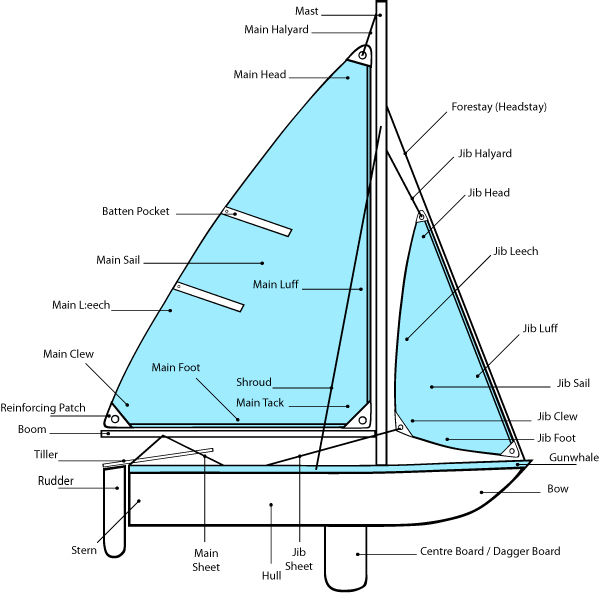
Tiller of a sailboat
When Charbonneau, husband of Sacagawea, was at the tiller of the boat during the Lewis and Clark expedition, a strong wind tipped the boat and Charbonneau panicked. He didn't know how to swim! The fiddle player, Pierre Cruzatte (also known as Peter), who was one of the best boatmen of the expedition, had to threaten to shoot Charbonneau to get him to grab the tiller!


Man steering boat using the tiller


As you can see by the above diagram, the tiller controls the rudder which steers the boat.

Thursday, November 8, 2012

The Society of the Black Mouths

Source: Wikimedia Commons
In the Mandan/Hidatsa/Minataree culture, there were men's societies similar to today's clubs or civic organizations. One of these societies was the Society of the Black Mouths. Members of this society were men who painted the bottom half of their mouth black, much like the above painting of a Minatare chief.

The societies each had their own dances, rattles, weapons, articles of clothing, body painting and hair style.

Societies were segregated by age. The Black Mouths were men in their 40s. When they became older they sold their membership and bought a membership in a higher society.

Two officers in this society carried "raven lances" into battle. If he was chased by the enemy he was to plant his lance in the ground and remain beside it to fight until killed or until a fellow tribesman pulled it out.


In the book, Waheenee, An Indian Girl's Story, a Hidatsa girl describes the Black Mouths as being bossy men who told the women when to clean up the village yard and inspected lodges to see how clean they were. Most of the women feared them and were submissive to them. The children feared them because of their bossy ways. If their orders were disobeyed, they punished the offenders by beating them or firing guns at their feet.

I thought this was an interesting detail of daily Hidatsa life and included it in my book about Sacagawea.

Tuesday, November 6, 2012

A Hidatsa Wedding


When Sacagawea married Charbonneau, she probably didn't have the type of ceremony a young Hidatsa woman would typically have had because she was a slave marrying a French fur trader.

When writing the book, Sacagawea, I had no way of knowing what her ceremony was like because it wasn't recorded. However, I do know that the caliber of the wedding in Hidatsa tradition depended on the status of the bride and her family. Much like it is in many cultures today. The more wealthy a family is, the more elaborate the wedding can be.

Betrothal happened sometimes in childhood, but it wasn't unusual for a young man to approach the father of the girl he admired and ask if he could marry her. The girl usually had no choice in the matter. She was brought up to trust her father's judgement and abide by his wishes.

For six days the mothers of the girl (Hidatsa men had more than one wife and the wives of the lodge were the mothers of the children) prepared feast foods for the wedding. On the sixth day the girl's family carried gifts and the feast foods to the groom's lodge.  The food may have been made of boiled dried green corn and ripe corn pounded to meal and boiled with beans.

Lewis and Clark Trail Blog
Inside the groom's lodge he sat on his bed that served as a couch during the day. The Hidatsa built beds off the floor on the outside walls of their lodge, very similar to how the Vikings fashioned their lodges.

The food was set near the fire. Gifts were exchanged. The groom may give horses to the bride's father and the bride's family may gift the groom with furs and horses. Generosity was a matter of pride. The Hidatsas wanted to give more valuable gifts than they received.

The women sat on the floor with their ankles to the right, the proper way for a Hidatsa woman to sit. The groom's mother might fill a wooden bowl with dried buffalo meat, pound it to a powder and mix it with marrow fat and offer it to the bride to eat. If the bride couldn't eat it all, she would fold it up in her robe and take it home. Hidatsa's always took any food they couldn't eat home with them. To not do so was an insult to the cook.

The groom's family would pack up the gifts given to the bride and take them to the bride's family lodge and present them to the bride's mother.

For the next two days the bride would busy herself decorating a couch/bed appointed as the marriage bed for the new couple in her father's lodge.

At the end of the second day, the bride's mother would tell her to go and call her husband, and to tell him that she wanted him to come to her father's lodge. The groom would go to the bride's father's lodge a few minutes after her request because young men didn't walk through the village with the woman they loved in the daytime as it was considered foolish.

After the groom spent the wedding night in the bride's father's lodge, he became a member of the bride's family, and the marriage ceremony was complete.


Friday, November 2, 2012

Grizzly Bears and Sacagawea

Grizzlies foraging; Source: Wikimedia Commons

The Shoshone Indians tell a story about a fight between a grey grizzly bear and a black bear. Some people think that there used to be polar bears in Idaho because Lewis and Clark reported seeing them.

In April 1805, Captain Lewis wrote in his journal:

"We...found many tracks of the white bear of enormous size, along the river shore and about the carcasses of the buffalo, on which I presume they feed. We have not as yet seen one of these animals, though their tracks are so abundant and recent...The Indians give a very formidable account of the strength and ferocity of this animal, which they never dare to attack but in parties of six, eight, or ten persons, and are even then requently defeated with the loss of one or more of their party" (Animals on the trail with Lewis and Clark by Dorothy Hinshaw Patent.)

Did grizzlies interbreed with polar bears as far south as Idaho?

Not necessarily. As you can see by this picture, the way the light shines on the bears' coats makes it look like a shade of grey.

Another example of a "grey grizzly" here:

Source: Wikimedia Commons
This fellow's coat reminds me of a "silver back" gorilla's. 

What do you think Lewis and Clark really saw?